You can learn to read tarot without an esoteric education, an initiation or a “gift” — you need the logic of the cards, a simple step-by-step method and a bit of practice. What frightens most people isn't the cards but not knowing what actually happens: what do you do with your hands, how do you phrase the question, how many cards do you draw, and what if something alarming like the Tower or Death turns up? In practice the whole process fits into six clear steps you could run through this evening. This guide covers all of it: what you need, how to settle and phrase your question, how to shuffle and choose a spread, how to interpret without cramming, a full worked example and the questions beginners ask most.
What you need to read tarot
The minimum is simple: a deck and a quiet spot where nobody will interrupt you for ten or fifteen minutes. Beginners are usually pointed at the classic Rider–Waite deck, because every card — including the minor arcana — carries a detailed scene rather than a pattern of cups or swords. That means you can understand a good deal from the picture alone, before you know any meanings. Most modern references, ours included, are written around that system, so the interpretations will line up: see our tarot card reference.
No physical deck yet? That's no reason to put it off. Start with a card of the day online or put a question to Mira in the bot, and buy a deck when you feel like holding the cards. Plenty of readers keep a paper and a digital practice side by side.
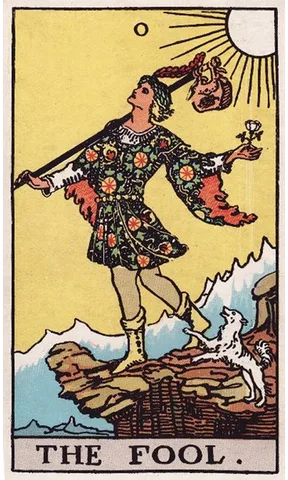
The Fool — the start of the road
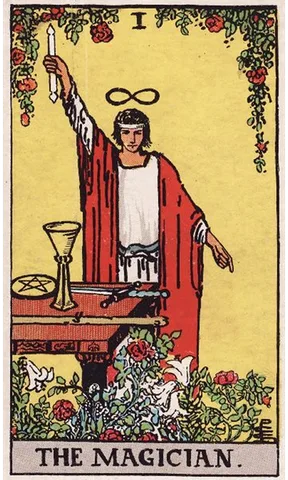
The Magician — will and resources
Beyond the deck you need very little: a flat surface (a table, the floor, a wide windowsill), and if you like, a notebook for your spreads and a candle or low light for the mood — though that's ritual, not a technical requirement. The main instrument in a reading isn't the accessories, it's your concentration.
How to read tarot: six steps
Here's the whole process in order, from settling down to interpreting. The method works for any spread, from a single card of the day to a full Celtic Cross.
Step 1. Settle yourself
Tarot is a tool for working with the subconscious and for reflection, not a magical instrument with a guaranteed output. Before a reading it matters to quiet the mind: find somewhere quiet, put the phone down, take a few slow breaths. Your inner state directly affects how honestly and clearly you read the cards — in a rush it's easy to skip the important detail or bend the interpretation toward what you want to hear.
If the subject genuinely upsets you, don't read on raw nerves. Better to breathe out first and draw afterwards — or let the bot lay the spread, where your own emotional stake gets in the way less.
Step 2. Phrase the question
A good question is half the answer. Tarot responds far more readily and precisely to open questions than to straight yes/no ones (though there's a dedicated format for closed questions — the Yes/No spread). Instead of “Will he marry me?”, ask “What's happening in this relationship now, and where is it going?” Instead of “Will I get the job?” — “What should I bear in mind before this interview?”
- Ask about yourself and what you can influence — not “will I win the lottery” but “what should I be paying attention to in my finances”;
- One question per reading: don't mix work and your personal life in a single session;
- Hold the question in your head while you shuffle — that's the moment the cards are tuned to the situation.
A well-phrased question: “What do I need to understand about myself in this relationship right now?” — rather than “Does he love me?”. The first gives you a card you can grow from; the second is guessing blind.
Step 3. Shuffle
Shuffle in whatever way is physically comfortable, keeping the question in mind — there are no strict ritual rules here. Some people shuffle like a playing deck, some cut with the left hand (said to be the intuitive one), some split the deck into three and put it back together. All of those work; what matters isn't the technique but your focus on the question while you do it.
When it feels like enough — for some people that's a minute, for others five — stop and draw the number of cards you need: off the top, from a fan, or at random from the deck spread face down. The method of drawing isn't critical; the honesty of it is. Don't peek, and don't redraw a card because you didn't like it.
Step 4. Choose a spread
A spread is a set of positions, each covering one aspect of the question. Beginners do best moving from simple to complex:
| Spread | Cards | When to use it |
|---|---|---|
| Card of the Day | 1 | A daily practice, the mood and advice for the day |
| Yes / No | 1–3 | A fast answer to a specific closed question |
| Past — Present — Future | 3 | The basic read on any current situation |
| Relationship spread | 3–5 | Questions about a couple, feelings, where a union is going |
| Work spread | 3–5 | Career, changing jobs, conflict at work |
| Celtic Cross | 10 | A deep look at something complicated, once you have experience |
The full catalogue with every position described is in all tarot spreads. Don't chase card count: three positions read thoughtfully are usually worth more than ten laid out in a hurry.
Step 5. Interpret the cards
This is where beginners get stuck, trying to recall the exact textbook meaning of each card. Don't try to memorise all 78 — it's slow, dull and, more importantly, it gets in the way of intuition. Work through this instead:
- Your first reaction. Look at the card before any analysis: what do you feel, what is the figure doing, what's the overall mood — bright, anxious, calm? The intuitive response is often more accurate than a dry definition;
- Suit and number (for the minors) or the story (for the majors). Cups are feeling, Swords are thought and conflict, Wands are energy and action, Pentacles are money and the everyday. The number tells you the stage: a Five is nearly always a crisis, a Ten the close of a cycle;
- Check the reference and join the textbook meaning to your intuitive impression — they usually agree about eighty per cent of the time, and the gap between them points at something personal and important;
- Note the orientation. Upright strengthens the core meaning; reversed usually weakens, blocks, delays or turns it. There's a full treatment in “Reversed tarot cards”;
- Tie the cards into a story. Don't look at them separately, like dictionary words — look at how they add up to a connected account, with a setup, a turn and an outcome.
The Major Arcana (from the Fool to the World) speak of large, largely fate-shaping themes and lessons; the Minor of specific everyday matters, feelings and decisions. To understand the system properly — suit plus number plus orientation — see “Tarot card meanings”. And you can look up ready-made pairings in card combinations.
Step 6. Tie it into one story
The final and most important stage isn't retelling each card separately but assembling a whole answer to the question you asked. This is where a reading stops being word-guessing and becomes actual reading. Say the spread out loud, as a short story: what was, what's happening now, what follows, and what you might do. If the story won't come together, go back to the question — it was probably too vague.
A worked example
Here's a full reading, from question to conclusion, so you can see the whole process.
The question: “What do I need to understand about my situation at work?” — note that it's open and focused on what the querent can actually influence.
The spread: three cards, Past — Present — Future.
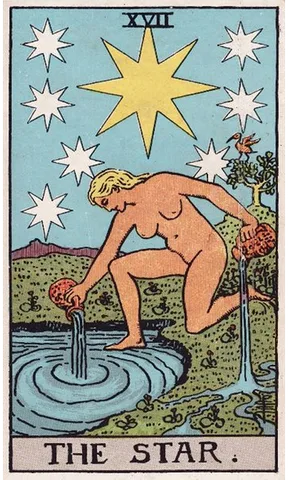
The cards: the Ten of Swords (upright) — the Star (upright) — the Eight of Pentacles (upright).
- The Ten of Swords (Past) — a punishing, draining period is already behind you: overload, hitting bottom, burning out in the old place or the old role;
- The Star (Present) — relief is arriving now, hope and clarity with it; you're starting to see light ahead and find the energy to move;
- The Eight of Pentacles (Future) — ahead is a stretch of focused, painstaking work and growing craft that gradually gets you a result.
The story: the burnout is over (the Ten of Swords), this is a time for recovery and reappraisal (the Star), and what's coming isn't an instant breakthrough but honest work on yourself and your skills that will pay off (the Eight of Pentacles). The practical advice: don't force it and don't grab at everything at once — pick one direction and put yourself into it steadily. Note again that no single card would have produced that answer; the meaning came out of how they connect and the order they fell in.
Common beginner mistakes
- Re-asking. One question, one reading. Asking again and again until the “right” answer appears is a reliable way to confuse yourself and lose trust in the practice;
- Fear of the “bad” cards. In the overwhelming majority of spreads Death is change and the end of a cycle, not a literal death; the Tower is illusions falling and release from what was only ever propped up. Tarot doesn't hand down verdicts;
- Cramming instead of intuition. The reference meanings are a foothold, not dogma to be repeated word for word;
- Reading while distressed. When you're upset it's easy to read what you want into a card — better to breathe and come back later;
- Ignoring orientation. Upright and reversed can put the emphasis in noticeably different places — don't skip it if you've decided to work with reversals;
- Mixing several questions into one spread. A reading loses focus if halfway through you mentally switch from work to your relationship.
How to learn faster
There's one secret, and it's regular practice rather than theory read in one sitting. What actually speeds things up:
- Draw a card of the day every morning and check in the evening: how did the card's meaning show up in the actual day? In a month you'll have lived about thirty cards — that sticks far better than a list of definitions;
- Keep a short journal. Write down the question, the cards and your interpretation, then come back a week or two later and compare it with what happened;
- Learn the cards as a system, not a list. First the four suits and their areas of life, then the logic of the numbers from Ace to Ten, and only then the 22 Major Arcana as characters in a story — that system is laid out in “Tarot card meanings”;
- Practise on real questions, not invented ones. Abstract practice spreads stick far worse than the ones where you genuinely wanted the answer.
If you'd like to look at the deck itself — how many cards, what each suit means — read “The tarot deck”, and for practice on a specific closed question, “Yes or No tarot online”.
Reading tarot online
While you're building confidence, reading online isn't a lesser form of the practice — it's a convenient way to learn from live examples without needing a deck in your hands. Put your question to Mira in our bot: she shuffles honestly for your question, draws the cards into a suitable spread and gives you a full interpretation in words — accounting for the suit, the orientation and the neighbouring cards, not just naming what fell.
→ Ask your question and get a reading from Mira
Frequently asked
Can I read tarot for myself?
Yes, it's the normal practice. The thing that matters is staying honest and not bending the interpretation toward the answer you want. If the subject affects you too much to look at the cards squarely, ask the bot or another person for the reading.
Do I have to memorise every card?
No. Lean on your intuitive response and the image, and use the reference as a prompt rather than an exam. The meanings settle in on their own with practice — fastest through a daily card.
How often can I read?
A card of the day, as often as you like — it's a daily practice with no limit. But don't re-ask the same question about a specific situation: the first answer is usually the honest one, and re-asking only compounds the anxiety and the confusion.
Which spread should a beginner start with?
The Card of the Day and the simple three-card Past — Present — Future. Leave the Celtic Cross for later: ten positions take experience to interpret and to tie into a story.
What if a frightening card like the Tower or Death turns up?
Don't panic. Death almost always means a stage ending and transforming, not a literal one; the Tower is a sharp but freeing collapse of illusions. Read cards like these in the context of the question and their neighbours — usually they signal a change that was already due, not a catastrophe.
Do I have to use reversals?
Not from the start. Many experienced readers never use them at all and read a card's shadow from the context of the spread. If reversals only confuse you, read upright positions only to begin with — that's an entirely legitimate practice.
How long does it take to read confidently?
For most people, confident reading of simple spreads takes four to six weeks of daily card-of-the-day practice plus a weekly three-card spread. Complex layouts like the Celtic Cross take longer — and what helps there is the number of spreads you've lived through, not the amount of theory you've read.
Can I read for other people as a beginner?
You can, as long as you say honestly that you're learning and don't present your interpretation as absolute truth. Reading for people close to you is good practice, but remember the responsibility: don't frighten anyone with the “bad” cards, and don't give advice in place of a professional where one is actually needed.