The card of the day is the simplest and at the same time the most useful practice in tarot: one card in the morning, one minute of attention, and you spend the whole day looking at what happens a little more consciously. It isn't a prediction of fate or fortune-telling in the usual sense but a tool for tuning your attention: the card doesn't dictate what will happen, it suggests where to look so you don't miss what matters. This guide covers why to draw a card of the day at all, how to do it properly, how to interpret the card practically — with examples from specific arcana — how to keep a card-of-the-day journal, how the practice differs from a full spread, and which mistakes most often stop people getting anything out of it.
Why draw a card of the day
The main beginner's misconception is to treat the card of the day as a mini-prediction: “the Sun came up, so the day will be easy”, “the Tower came up, so disaster is coming”. In fact it works differently. It isn't a message from the future but a tool for self-reflection: it sets a frame through which you observe what's already happening.
Psychologically this resembles priming: if you read in the morning that today is a day to pay attention to detail, you really do start noticing details — not because the card “knew the future” but because you tuned your attention. The reverse works too: the card helps you recognise patterns you'd otherwise miss. If cards about pause and rest come up several days running while you're ignoring your tiredness, that's a cue to listen — not to the cards, but to yourself.
The second purpose is learning. The card of the day shows you not an abstract book definition but a live one, in the context of your actual day. Watching how an arcanum's meaning shows up in concrete situations, you memorise tarot card meanings far faster than by drilling lists. It's one thing to read in a reference that the Eight of Swords is about feeling trapped and limiting beliefs, and quite another to notice, during the day, a moment when you built an obstacle for yourself where none physically existed. That kind of observation stays with you for years, not until the exam.
And third: the card of the day is a small daily ritual that creates a pause for contact with yourself. The card doesn't “run” your day — you do, and by spending a minute on a question and a draw you start the day slightly more consciously than on autopilot. In that sense it's close to practices like morning pages or a short meditation: what matters isn't a mystical mechanism but the simple fact that you stopped for a minute and asked yourself what deserves attention today. Regularity works better here than intensity: five minutes every morning gives you more than one long spread once a month.
There's a more practical layer too. The card of the day is a kind of checklist for mood and priorities. When the morning starts chaotically and it's unclear what to grab first, the short ritual helps you single out one theme — communication, rest, work, boundaries — and keep it in focus instead of getting lost in small tasks.
How to draw a card of the day properly
Step 1. Pick the time — morning, before the rush
The best moment is right after waking, before the phone, the news and the to-do list. The mind is calm then and less cluttered with outside expectations, so the card lands more clearly. If mornings don't work, any calm moment before noon will do — the point is to get there before the day has already taken off.
Step 2. Frame the question — but frame it right
Don't ask “what's in store for me today?” — that invites you to read the card as a prediction. The right phrasing is different: “What should I pay attention to today?” or “What energy would be useful to me today?”. A small difference in words, an enormous one in substance: you're asking for a focus, not a forecast.
Step 3. Shuffle and draw one card
Shuffle calmly, holding the question in mind, and draw a single card — off the top or from a fan, whichever suits you. One card is enough: the card of the day isn't a spread with positions but a single marker.
Step 4. No redealing
This is probably the most important rule of the practice. If you don't like the card — the Tower, the Devil, the Ten of Swords — you don't draw again. The point of the ritual is precisely to take the day's prompt as it comes rather than shop for a comfortable answer. An “unpleasant” card is almost always more useful than a pleasant one: it's the one pointing at what you'd otherwise not notice.
How to interpret the card practically
Drawing the card isn't enough — the point is turning it into a concrete action for the day. A simple three-question routine works.
- What does the card say literally? Look at the image, recall or look up the basic meaning in the card reference.
- How might that show up today specifically? Translate the general sense into the language of your schedule: the meetings, tasks and conversations already planned.
- What practical advice follows? Formulate a single action sentence — “today, listen more than you speak” or “don't put off that call”.
Take the card's orientation into account too. Upright usually carries the main, direct sense of the advice. Reversed isn't a “bad” version of the card but rather an inner nuance, a warning or a delay: the card's energy is present but shows up indirectly, through resistance or a block. If you're just starting out it's perfectly fine to read upright meanings only for now — there's more on orientation in the article “Reversed tarot cards”.
Examples of card-of-the-day interpretations
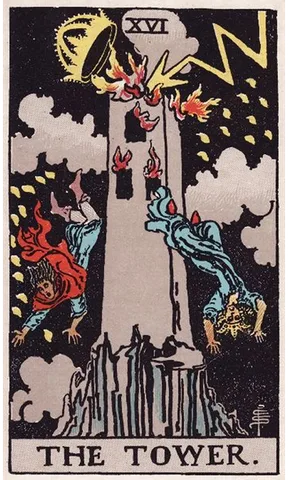
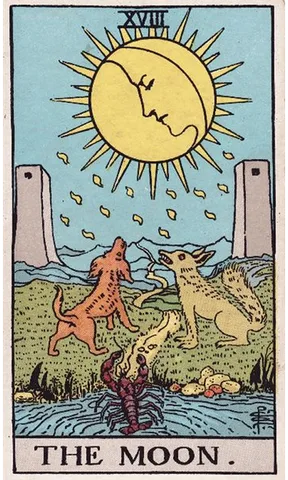
Here are a few telling cards and what to do with them practically during the day.
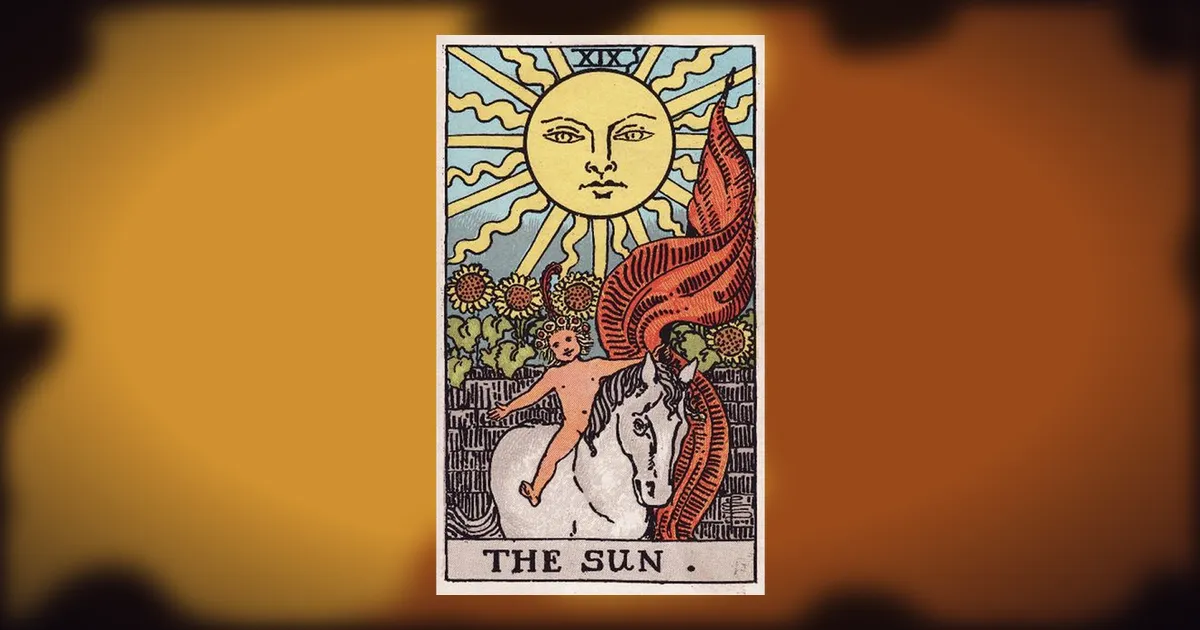
The Sun. One of the most favourable signs in the deck. The day will most likely go easily: good mood, work flowing, conversation bringing pleasure. Advice: don't hide that energy — schedule the important meetings, show your results, be visible.
The Tower. It frightens a lot of people, and it shouldn't. As a card of the day the Tower rarely means literal catastrophe — more often it's a day of unexpected changes, plans falling through, or a sharp clarification of something long overdue. Advice: stay flexible, don't cling to the schedule, treat surprises as information rather than failure.
The Moon. A day of heightened intuition and reduced clarity. Information may be incomplete and emotions misleading. Advice: don't force important decisions today, trust your sense of things more than the bare facts, and don't fill the gaps with worst-case guesses when what's missing is simply data.
The Magician. A day of personal initiative: you have everything you need to start something new. Advice: don't put it off — take the first step today, while the energy for action is high.
The Hermit. A day that leans towards solitude and pause. Advice: don't force yourself into social activity if you need quiet — today it's wiser to listen to yourself than to outside expectations.
The Star. One of the most hopeful cards in the deck. A day of recovery after a hard stretch, of gentle inspiration and quiet hope. Advice: don't push events — give yourself room to rest and trust that the difficult part is behind you.
The Empress. A day of care, abundance and creative energy. A good time to look after yourself, finish a creative project or simply surround yourself with comfort. Advice: don't economise on care — for yourself or those close to you — today.
The general principle, applicable to any card: first read the arcanum's basic mood — bright, anxious, neutral — and then look not for a literal match with the day's events but for a resonance with the inner state the card describes. That's exactly why the same card sounds different for different people and on different days while remaining true to itself.
Below is a summary table of a few common cards of the day, as a quick reference.
| Card | The day's energy | Practical advice |
|---|---|---|
| The Sun | Ease, success, good spirits | Schedule what matters, be visible |
| The Moon | Intuition, uncertainty, emotion | Don't force decisions, listen to yourself |
| The Tower | Change, surprises, plans breaking | Stay flexible, don't cling to the old |
| The Star | Hope, inspiration, recovery | Trust the process, allow yourself a breather |
| The Magician | Initiative, resources, beginnings | Take the first step today |
| The Hermit | Solitude, pause, inner search | Don't force company, give yourself quiet |
The card-of-the-day journal: why and how
A single card is just a prompt for one day. But if you record your cards for even a few weeks running, the practice moves up a level: you start to see patterns that are invisible in the moment.
The journal format is simple. Start a note — on paper or in your phone — and each evening record three things:
- which card came up in the morning, and in which orientation;
- what advice you drew from it;
- how, in your view, it showed up in the actual day — briefly, no half-page analysis.
After a month or two, reread the whole thing. Often you'll find that the same card or suit recurs around particular kinds of event, and that there's some advice you systematically ignored — and that those were exactly the days when the problems the card warned about turned up. A journal turns the card of the day from a pleasant ritual into a working instrument of self-observation.
The card of the day doesn't tell you what will happen. It tells you where to look to notice what's happening anyway.
Card of the day vs a full spread
The card of the day and a full spread solve different problems, and they shouldn't be confused. The card of the day isn't an answer to a specific question but a general background, the “weather” for twenty-four hours: it has no narrow topic, it's about the day as a whole.
If you have a specific question — whether to take a step, what's happening in a relationship, how the week will go — the card of the day won't do the job: for that, turn to a themed spread. The Yes/No spread for closed questions, for instance, or the love spread or the week spread for a wider horizon. If the question is complex and layered, a large spread such as the Celtic Cross suits better. And if you're only just getting to grips with cards and spreads in general, start with the basic guide “How to read tarot”.
The card of the day is good precisely for its simplicity and regularity: it doesn't replace a spread, it complements one — the way daily stretching doesn't replace a workout but keeps you in shape between them.
Typical mistakes in the card-of-the-day practice
- Redealing. Drawing repeatedly until a “nice” card comes up is the most common and most destructive mistake. It devalues the whole idea of looking at your day honestly.
- Treating it as a hard forecast. “The Ten of Swords came up, so today is definitely going to be terrible” turns the practice into a source of anxiety instead of support. The card shows a likely energy, not a verdict.
- Ignoring the advice during the day. Drawing a card in the morning and forgetting about it doesn't work either. The point is to come back to the advice, at least mentally, as the day goes on.
- Over-elaborate interpretation. There's no need to analyse a card of the day the way you would in a big spread, with every symbol and suit. One clear thought is plenty.
- Irregularity. Drawing a card once a fortnight when you happen to remember doesn't give the practice time to build the cumulative effect a journal produces.
Your card of the day online, every morning
You don't need your own deck or the meanings held in memory. Get a card of the day online with a short interpretation every morning: open the Card of the Day spread on the site whenever you like, and to have it arrive on its own, switch on notifications in the Telegram bot — Mira will send you the card and a short piece of practical advice each morning.
→ Open the bot and get your card of the day from Mira
Frequently asked questions
When is the best time to draw a card of the day?
In the morning, before the day's business begins — that way the card sets the tone and is easier to keep in focus. If the morning doesn't work, any calm moment before noon will do.
Can you redraw if you don't like the card?
No. The point of the practice is to take the day's prompt as it comes rather than shop for a comfortable answer. The “unpleasant” card usually turns out to be the most useful one.
What if the same card comes up every day?
That's a signal: this card's theme matters particularly to you right now and deserves separate attention. It's worth thinking about what in your life it reflects, and possibly turning to a fuller spread.
Should reversed cards be taken into account in a card of the day?
That's your choice. Beginners can read upright meanings only at first — that's an honest, workable practice too. With experience, a reversed position adds a useful nuance: a warning or a delay.
How does a card of the day differ from a spread on a specific question?
The card of the day is a general background for the day, with no narrow topic. For a specific question — whether to do something, how a relationship is going — use a themed spread, such as Yes/No, or card combinations for deeper analysis.
Do you have to keep a journal?
You don't have to, but it's extremely useful. A journal lets you see patterns across several weeks — things that are invisible when you look at a single card once.
Can a card of the day be wrong?
The card of the day isn't a hard forecast but a focus of attention. It doesn't literally “come true” or fail to: its job is to highlight what deserves your attention, not to predict an event in detail.