The Moon is the eighteenth major arcanum and the most anxious card in the deck. Not the most frightening — that title goes to Death or the Tower, but those are honest and quick. The Moon works differently: it doesn't strike, it shows things as other than they are. Let's go through what the Moon means upright and reversed, why it is about anxiety more often than deceit, and how to tell intuition from your own fear.
What the card shows
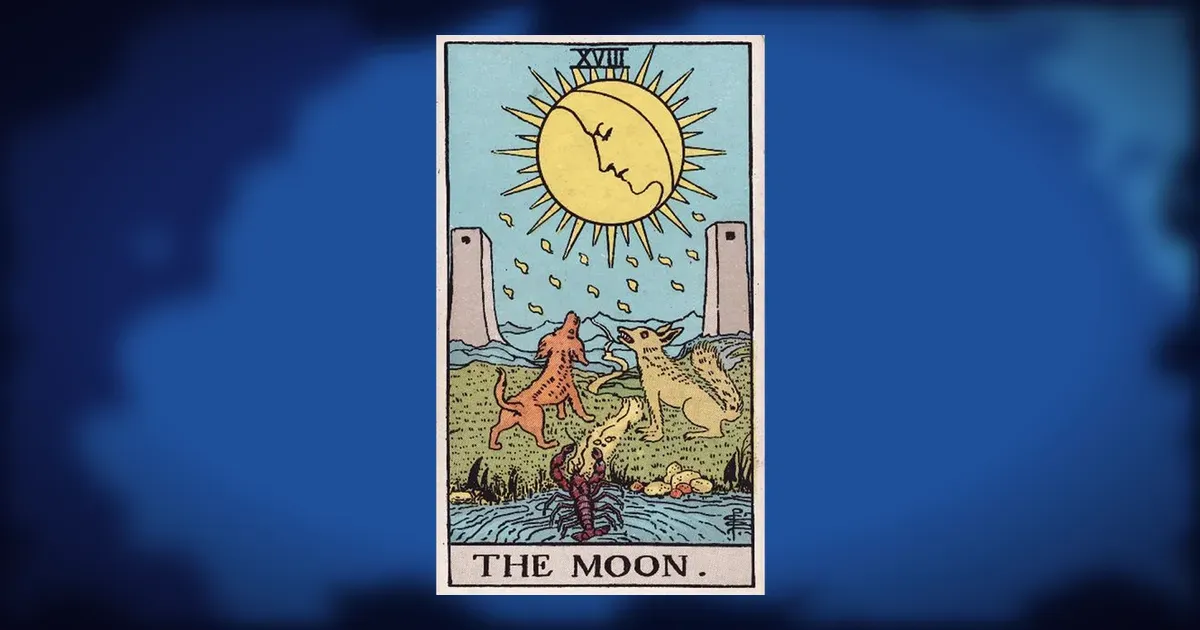
On the Waite card: a night landscape and a path leading away between two towers. A crayfish crawls out of the water, a dog and a wolf howl on the path, and above hangs a moon with a human face shedding drops of light.
Every detail serves one theme — the conscious against the subconscious. The crayfish climbing out of the water is what rises from the depths: old fears, forgotten hurts, dreams. The dog and the wolf are the same animal in two states, tamed and wild. What looks domestic by day shows its teeth at night.
The two towers are a gate beyond which you cannot see. The path exists, but it is lit by reflected light rather than by the sun. Hence the card's central property: you can walk, you can't see well. The Moon doesn't forbid movement; it warns that your sense of distance is currently off.
The Moon upright
Upright, the Moon means illusion, anxiety, uncertainty and an active subconscious. It appears in a spread when the picture of a situation is distorted — and distorted more often from within than from without.
That correction matters. Most interpretations reduce the Moon to deceit: "you are being lied to", "something is being hidden from you". That reading is possible, but it is secondary. In the overwhelming majority of spreads the Moon says something else: you see the situation through your own fear. Nobody is lying — the picture in your head is simply more vivid than reality.
The Moon rarely answers "what is actually happening". It answers "why you can't make it out".
In love
The commonest position for this card, and the most painful. In a relationship spread the Moon means things left unsaid: something between you is unresolved and you are each filling the gap your own way. You read silence as cooling; they read your reserve as indifference; and both of you are sure the reading is correct.
The card does not say "they are cheating on you", though it is often read that way. It says: you don't have enough data, and your mind filled the gaps with the worst option. That is tested with one direct question, which usually hasn't been asked.
At work
In work spreads the Moon points at opacity: unclear terms, unspoken details, promises without specifics. Here the deceit reading becomes more plausible — yet even here the card advises clarifying rather than suspecting. Ask for written wording, deadlines and figures.
In how you feel
The Moon is linked to cycles, sleep and the nervous system. In wellbeing spreads it often turns up during insomnia, anxiety and general exhaustion — when fatigue has built up enough to distort perception. That isn't a diagnosis but a description of a state in which every decision comes out worse than usual.
The Moon reversed
Reversed, the card reads noticeably lighter than upright: the fog lifts, fears lose their grip, the truth becomes visible.
Release from illusion. What seemed like a catastrophe turns out smaller. The card often arrives after a period of anxiety, as a sign that it is ending.
What was hidden comes out. The missing information arrives: the conversation finally happens, the details become clear, the misunderstanding is explained.
Loss of sensitivity. A rarer reading, but it occurs: someone has grown so tired of being afraid that they've stopped hearing the real signals too. Then the reversed Moon advises not to discard intuition along with the anxiety.
Upright and reversed by area
| Area | Upright | Reversed |
|---|---|---|
| Love | Things unsaid, assumptions, jealousy without facts | The conversation happens, the misunderstanding clears |
| Work | Unclear terms, promises without specifics | Details clarify, the contract becomes readable |
| Money | Don't estimate by eye — the figures don't add up | Something lost is found, a forgotten debt surfaces |
| Health | Insomnia, anxiety, accumulated fatigue | Sleep returns, the anxiety recedes |
| Advice | Don't make decisions today | You can act; the picture is clear |
Telling intuition from anxiety
This is the practical question the Moon answers, and the two are confused constantly. Both feel like "something isn't right". There is a difference, and it is noticeable.
- Intuition speaks once and calmly. The thought arrives, leaves a sense of clarity, and doesn't demand immediate action.
- Anxiety repeats in circles, gaining volume and new details with every turn.
- Intuition is about the present: "something here doesn't add up".
- Anxiety is about the future: "what if it happens", "what if they", "what then".
- After intuition comes relief — it's clear what to do.
- After anxiety comes tiredness and the urge to check your phone again.
If it comes out as anxiety by these signs, the Moon advises one thing: get the missing data. Not another reading, not a third question to the cards — a question to the person.
"Is he lying or am I imagining it": the common case
This is what people bring to the Moon most often, so let's take it honestly. The situation usually looks like this: someone started writing less, answering more briefly, cancelled a meeting — and inside you a whole version of events has already assembled itself.
What the card says at that moment: the version is built from three facts and twenty assumptions. The Moon doesn't deny that something changed. It points at the proportion: few changes, many interpretations.
The practical exercise takes five minutes. List in one column only what is observable — what the person did or said, without evaluation: "didn't answer until evening yesterday", "cancelled Saturday", "wrote first on Wednesday". Beside it list your conclusions: "gone cold", "there's someone else", "he's tired of me". Look at both columns together. Nine times out of ten the first is short, the second is long, and the link between them is not obvious.
From there you have exactly two paths, and both beat another reading. The first is a direct question: "am I imagining it, or has something changed?" The second is to give the situation a week and watch behaviour rather than your own reaction. The Moon's danger is that it pushes towards a third path — reading the same question again and again. That gives no answer and grows the anxiety beautifully.
What to do on a day the Moon appears
The card describes a state, and a state can be worked with. The order is simple.
- Postpone decisions. All of them: money, work, relationships. Don't cancel them, move them two or three days — that is usually enough.
- Collect facts. Clarify whatever can be clarified: ask for deadlines, reread the contract, put the direct question to the person.
- Check the basics. Sleep, food, water. The Moon often turns up on the third night of five hours' sleep — and then it's the regime that needs fixing, not the situation.
- Write down your dream. The eighteenth arcanum is linked with dreams, and on such days they are unexpectedly articulate.
- Don't re-read the cards. A second spread on the same question won't add clarity today; it will add options.
A day or two later it almost always turns out the situation was simpler than the night-time version. That is the Moon's work: it doesn't create the problem, it highlights how much you are adding to it.
The Moon with other cards
The neighbours decide which way to read the card — towards deceit or towards your own fear.
| Combination | How to read it |
|---|---|
| Moon + Seven of Swords | The one case where deceit becomes the main reading. Check the facts |
| Moon + High Priestess | There is a secret, but it isn't malicious: the person simply isn't ready to speak |
| Moon + Nine of Swords | Pure anxiety with no external grounds. Work with the state, not the situation |
| Moon + Sun | The fog lifts quickly and on its own. One of the best pairings for this card |
| Moon + Star | A murky period with a good outcome: trust returns |
| Moon + Eight of Cups | A departure into the unknown, and it is the right one, frightening as it is |
The principle of reading pairs is covered in the guide to tarot card combinations, and the meanings of all twenty-two arcana are gathered here. The Moon's own card page is here.
The Moon as card of the day
Drawn in the morning, the Moon sets a day of poor visibility. The practical consequence: not the best day for decisions, signatures or clearing the air — not because it is a "bad day", but because your assessment of things is currently skewed.
What to do with such a day: observe and gather facts, decide tomorrow. Pay separate attention to dreams — the eighteenth arcanum is traditionally connected with them, and on a day like this a dream often turns out unexpectedly clear. How to draw a card of the day properly is covered separately.
The Moon of the arcanum and the Moon in the sky
These are different things that rhyme, and confusing them is a mistake. The Moon arcanum is a symbol and doesn't depend on the phase overhead: the card means the same at full moon and at new moon.
The phase does affect the background, though: at full moon people sleep worse, react more sharply and make impulsive decisions more often. If you work with cards regularly it is useful to watch both — the lunar calendar shows today's phase and lunar day. "The Moon card drawn at full moon" isn't a stronger prediction, just a reason to be twice as careful with yourself.
Three mistakes when reading the Moon
First — reading it straight as infidelity. The commonest and costliest error. The Moon means a lack of information, not a fact of betrayal. Between "I don't know everything" and "I was betrayed" lies a chasm, and the card stands on the first bank.
Second — handing the decision to the cards. In fog you want to ask the deck once more, and again, until something pleasant comes up. The Moon is the one card that says directly: re-reading now is useless, because what is distorted isn't the spread but the person reading it.
Third — confusing it with the High Priestess. Both concern the hidden, but the Priestess is knowledge deliberately kept until its time, while the Moon is murk in which nobody sees anything — including whoever is supposedly hiding something.
Why the Moon frightens more than Death
An observation from practice: beginners fear Death and the Tower, while experienced readers respect the Moon. The reason lies in how these cards are built. Death and the Tower speak of an event — it happens, it ends, a new life begins. The Moon isn't about an event but about a state, and a state has no obvious end point.
Hence its reputation. People cope with a clear disaster — they can see what they are dealing with. Uncertainty is harder: it isn't clear what to fix, where to start or when it will end. That is exactly why the card turns up in drawn-out stories rather than acute crises.
The good news is built into the symbolism. The Moon wanes and grows; it never stands still. No fog holds forever, and in a spread the neighbouring cards usually confirm it: look at what landed in the outcome position — there is almost always something definite there.
The Moon and the number eighteen
Eighteen reduces to nine (1 + 8), and nine in the deck is the Hermit, the card of solitude and inner searching. The link is readable: the Moon puts a person in front of what lives inside them, and that has to be sorted out alone. You can calculate your own numbers on the numerology page and see the whole deck in the card catalogue.
If your situation is exactly this kind of fog and you'd like it read with the neighbouring arcana taken into account rather than by a general meaning, you can do that in Telegram.
→ Open the bot and ask the cards
Frequently asked questions
Is the Moon a bad card?
Not bad — inconvenient. It doesn't foretell disaster, but it honestly reports that you currently see the situation worse than it is, or worse than you'd like. Unpleasant and useful at once.
Does the Moon mean infidelity?
Not by itself. It means things unsaid and assumptions. Infidelity becomes plausible only beside the Seven of Swords, the Devil or reversed Knights — and even then it needs checking in reality rather than in the deck.
What does the Moon mean in a yes-or-no question?
It means "not clear yet" — the most honest answer available. Upright says there isn't enough data and the question is worth asking later; reversed leans towards "yes, but it won't become clear at once".
The Moon keeps coming up — what does that mean?
That the question is the wrong one. A repeating Moon usually means you are asking about another person when what needs sorting out is your own state. Try rephrasing from "what does he think" to "what is happening with me".
How does the Moon differ from the High Priestess?
The Priestess is knowledge that exists but is closed. The Moon is the absence of clarity as such. With the Priestess someone holds the truth; with the Moon nobody sees it, participants included.
Is the Moon dangerous in a health spread?
No. Most often it points at insomnia, anxiety and accumulated fatigue. Tarot doesn't diagnose: if something physical is troubling you, that is settled with a doctor rather than with a deck.
Can I trust my intuition when the Moon appears?
Carefully. The Moon is precisely when intuition is easiest to confuse with anxiety — the signs that distinguish them are above. A simple rule: intuition speaks calmly and once, anxiety repeats and grows.